

Controlling Hand-Arm Vibration: Dampening Strategies and Exposure Limits for Power Tools
On September 22, 2026 by lukasThe Mechanics of Hand-Arm Vibration and Workforce Risk
Hand-arm vibration becomes a workplace hazard when mechanical energy from a tool reaches the operator”s hands and arms at sufficient magnitude, duration, and frequency. The transmission path includes the tool structure, handle, gloves, skin, soft tissue, bones, joints, muscles, and vascular and neural systems. Grip force and feed force matter because they alter both contact stiffness and the amount of energy transferred into the body. A tool that appears acceptable in a laboratory can therefore produce a materially different operator exposure when used against a hard workpiece, with excessive gripping, or with worn bearings and misaligned attachments.
Hand-Arm Vibration Syndrome, or HAVS, is associated with progressive vascular and neurological damage. Early symptoms can include tingling, numbness, reduced tactile discrimination, and loss of grip strength. Vibration-induced blanching, commonly called vibration white finger, reflects impaired blood flow that may be triggered by cold or further vibration exposure. Because neurological and vascular changes can develop gradually, engineering controls must take priority over reliance on worker awareness, gloves, or informal breaks. The specification-first objective is to reduce vibration at the source, isolate the handle from the vibrating mass, and then use mathematically controlled exposure schedules as a secondary barrier.
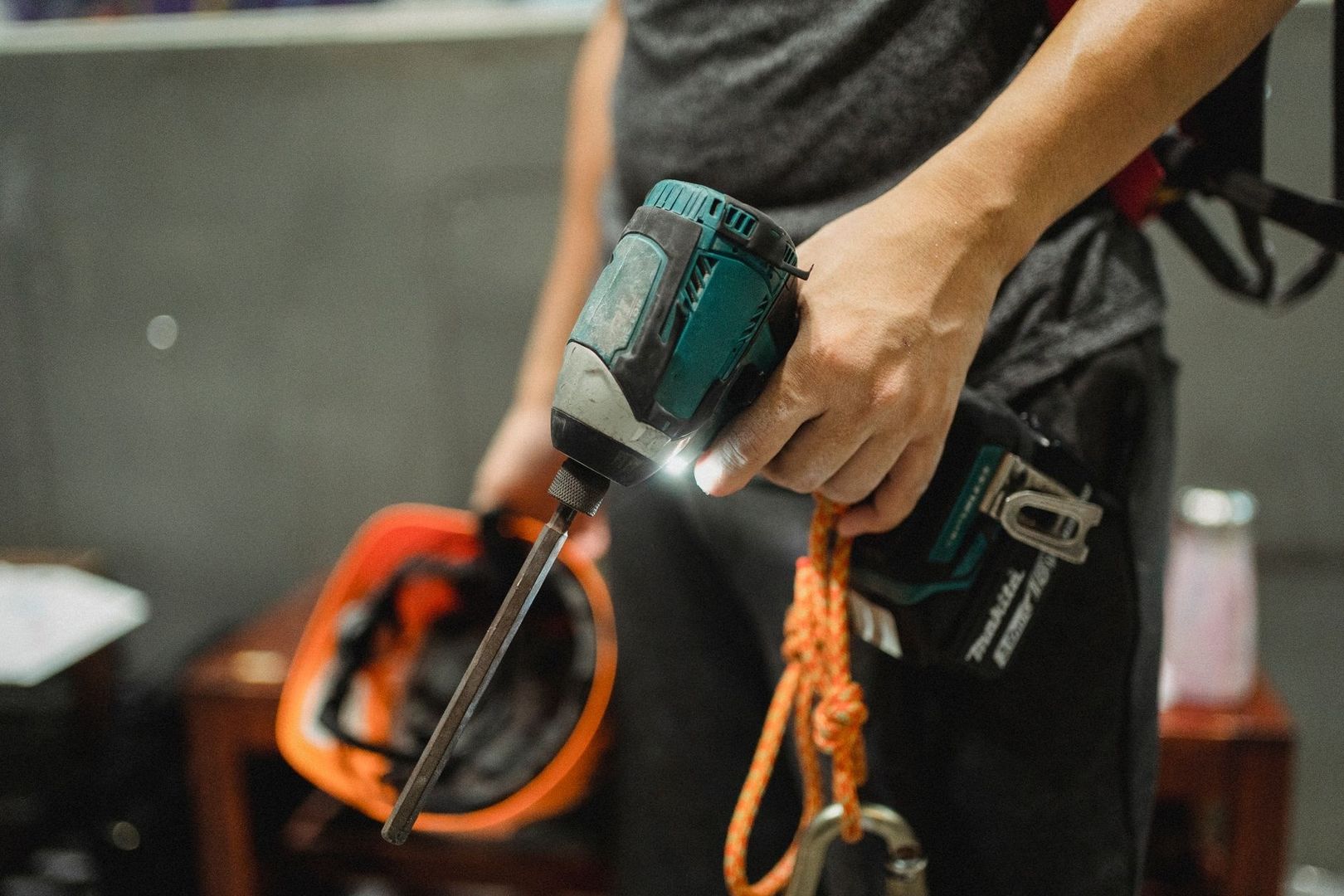
Vibration Waveforms and Transmission Characteristics in Handheld Equipment
Handheld equipment does not produce one universal type of vibration. A grinder or rotary sander may generate relatively continuous harmonic vibration related to rotor imbalance, bearing condition, gear mesh, or abrasive imbalance. An impact wrench, riveting tool, breaker, or demolition hammer instead produces repeated shock events separated by lower-vibration intervals. These impulses can contain brief, high-amplitude peaks that are not adequately represented by a simple average sensation. The 2026 publication of the national version of ISO 5349-3 addresses measurement and evaluation of hand-transmitted shock vibration, including isolated and repeated events, shock counts, rates, and peak magnitude.
ISO 5349 assessment uses frequency-weighted acceleration so that measured vibration reflects the varying sensitivity of the hand-arm system across the relevant frequency range. The nominal octave-band range extends from approximately 8 Hz to 1,000 Hz, while shock events may contain significant energy at the upper end of, or beyond, that range. Low-frequency vibration tends to produce larger displacement and can challenge posture, grip stability, and joint control. Higher-frequency energy may be strongly attenuated by some structural elements while still creating local stress in fingers, hands, and soft tissue. The correct design question is therefore not simply whether a handle feels soft, but whether its dynamic response is appropriate for the tool”s measured frequency profile.
Clinical evidence and occupational reviews, including the review available through Checking your browser, connect sustained exposure with vascular, sensory, and neuromuscular impairment. Established occupational medical protocols, such as HSE health surveillance guidance, should be consulted alongside formal measurement standards to identify early neurosensory and vascular changes before permanent disability occurs. The practical implication remains clear: triaxial measurement, frequency analysis, and medical surveillance should be treated as complementary systems rather than separate compliance exercises.
- Continuous rotary vibration requires attention to imbalance, bearing wear, gear excitation, and resonance.
- Impulsive tools require evaluation of peak events, repetition rate, and shock transmission through the grip.
- Frequency weighting supports exposure comparison, but it does not replace waveform-specific engineering assessment.
- Grip force, workpiece stiffness, operator posture, and attachment condition can materially change field exposure.
Dampening Architecture: Elastomeric Isolators versus Pneumatic Air Cushions
Elastomeric isolators work through a combination of stiffness and viscoelastic loss. A polymer bushing, compliant handle mount, or viscoelastic grip layer deforms under dynamic shear and converts part of the vibration energy into heat. Selection must account for hardness, thickness, temperature range, compression set, fatigue resistance, chemical exposure, and the direction of loading. A soft material is not automatically a better isolator. If its stiffness is too low, the handle may move excessively, reduce tool control, or allow the system to enter a resonance region. If it is too stiff, it may transmit excessive high-frequency energy.
Pneumatic systems use compressed air as a compliant medium. Air cushions, counterbalances, and dual-chamber arrangements can separate an operator interface from a vibrating mass while maintaining useful load support. In heavy demolition equipment, the pneumatic architecture can be tuned to manage large stroke forces and repeated impact events that would otherwise pass directly through a rigid handle. However, performance depends on pressure stability, seal condition, chamber geometry, temperature, and maintenance. A pneumatic isolator that leaks or operates outside its designed pressure range may provide inconsistent protection and introduce control problems.
| Selection criterion | Elastomeric isolators | Pneumatic air cushions |
|---|---|---|
| Tool weight and packaging | Compact, low part count, usually easy to integrate | May require chambers, hoses, valves, and additional service space |
| Operator precision | Good when stiffness is tuned to the load and frequency profile | Can provide excellent isolation, but excessive compliance may affect control |
| Thermal stability | Polymer properties can change with temperature and aging | Pressure, seals, and air temperature influence performance |
| Isolation efficiency | Effective across selected frequency bands and shear directions | Strong potential for low-frequency and high-force isolation when correctly tuned |
| Lifecycle risk | Watch for cracking, hardening, fatigue, and compression set | Watch for leaks, seal wear, pressure loss, and contamination |
From datasheet to deployment, the isolation architecture should be validated under realistic loads rather than selected from nominal material labels. A polymer handle wrap may absorb shock and improve comfort, but it cannot correct an unbalanced rotor or eliminate structural resonance. A pneumatic handle can reduce transmitted energy, yet it still requires a stable grip interface and fail-safe behavior if pressure is lost. Procurement specifications should request measured vibration before and after the intervention, with test conditions, axes, frequency weighting, tool configuration, and operator loading clearly documented.
Standard Exposure Thresholds and Mathematical Rotation Frameworks
Under the commonly applied hand-arm vibration framework, the Exposure Action Value is 2.5 m/s² A(8), equivalent to 100 exposure points. The Exposure Limit Value is 5.0 m/s² A(8), equivalent to 400 points. A(8) expresses the equivalent daily exposure normalized to an eight-hour reference period. These values are not permission to operate continuously at the limit. The action value triggers preventive measures, while the limit value establishes a boundary that must not be exceeded in normal work planning.
For multiple tools, exposure must be combined mathematically rather than estimated by adding hours alone. If a tool has vibration magnitude a and operating time T, its partial daily exposure is proportional to a²T. The combined result is obtained from the square root of the sum of the squared partial contributions, normalized to the reference day. This means a short period with a high-vibration impact tool can dominate a shift that also contains longer periods of lower-vibration work.
Supervisors can use The hand-arm vibration exposure calculator to enter representative magnitudes and durations for up to six machines or processes. The spreadsheet reports partial exposure, total daily A(8), exposure points, points per hour, and the time required for a tool to reach the action and limit values. Values should be based on reliable field data or appropriately conservative manufacturer information, not on an optimistic rating from an unrelated configuration.
- Record the representative triaxial vibration magnitude for every tool and attachment combination.
- Convert each planned trigger time into a partial dose using the tool”s vibration magnitude and exposure duration.
- Combine the partial doses by the square-root-of-sum-of-squares method, or use the HSE exposure-points system.
- Assign work so the individual total remains below the action value wherever reasonably practicable and never exceeds the limit value.
- Recalculate the schedule when tools, materials, operators, production rates, or maintenance conditions change.
Rotation is effective only when it controls actual trigger time. Travel, setup, inspection, and breaks may be non-vibration time, but they should not be counted as exposure reduction if the tool remains running or is used intermittently during those activities. Automatic shutoff devices can help enforce maximum operating periods, while digital time records and supervisor checks reduce the risk of informal workarounds. Piecework incentives require particular caution because speed pressure can increase gripping force, shorten recovery periods, and encourage operators to exceed the planned dose.
Retrofitting and Secondary Mitigation Strategies
Retrofitted decoupled handles and auxiliary grips can improve isolation when the original tool interface is rigid or poorly shaped. A vibration-damping side handle may increase stability and reduce the force required to control a drill, sander, or grinder. The component must still fit the tool body securely, preserve access to controls, withstand reaction torque, and maintain its damping properties under the operating temperature and contamination conditions. Increasing grip diameter can reduce localized hand pressure, but an oversized or slippery grip may force greater muscular effort and negate part of the benefit.
Viscoelastic wraps are useful as secondary controls, especially for reducing shock transmission at the contact surface. Their limitations must be stated clearly. A wrap cannot isolate the entire hand from low-frequency tool movement, and it may compress, harden, peel, or absorb oils over time. Maintenance should also address the vibration source itself. Rotors and abrasive wheels should be balanced, pneumatic pistons lubricated according to the tool specification, bearings replaced when degraded, and chucks or holders checked for alignment. Any rise in vibration after a repair or tooling change should trigger measurement rather than an assumption that the accessory is still safe.
- Verify handle attachment torque, clearance, and reaction-load capacity.
- Inspect polymer surfaces for hardening, tears, delamination, and compression set.
- Check pneumatic pressure, seals, hoses, lubrication, and contamination control.
- Balance rotating assemblies and replace worn bearings before vibration becomes operator-visible.
- Measure the complete tool and attachment assembly after significant maintenance.
Implementing a Zero-Harm Tool Lifecycle and Operational Protocol
A credible zero-harm objective begins with procurement. Tooling specifications should require verified triaxial vibration ratings, declared measurement methods, operating conditions, attachments used during testing, and evidence that ratings are representative of production work. A low nominal number without test context is not decision-ready data. Engineering teams should compare isolation efficiency against tool mass, balance, control response, thermal behavior, maintenance access, replacement-part availability, and total lifecycle cost.
Predictive maintenance should connect vibration data with asset history. A gradual increase in acceleration, shock peak, or spectral energy can indicate imbalance, bearing deterioration, piston wear, loose fasteners, chuck misalignment, or degraded isolators. The final operating protocol should include:
- Source reduction through low-vibration tool selection and tuned isolation.
- Commissioning measurements for each critical tool, attachment, and operating mode.
- Exposure-point or A(8) calculations before assigning shift patterns.
- Trigger-time controls supported by supervision, records, and automatic shutoff where suitable.
- Training on relaxed grip technique, warm and dry hands, early symptom reporting, and correct tool use.
- Health surveillance capable of identifying vascular, sensory, and functional changes early.
- Scheduled inspection and predictive maintenance tied to measurable vibration trends.
This layered approach reduces lifecycle risk because it treats HAVS as a system-design problem rather than an operator-compliance problem. Mechanical dampening must match the waveform and frequency profile, while exposure rotation must be calculated from actual vibration magnitude and trigger time. When procurement, maintenance, measurement, and workforce planning use the same verified data, protection becomes repeatable, auditable, and fit for the application.